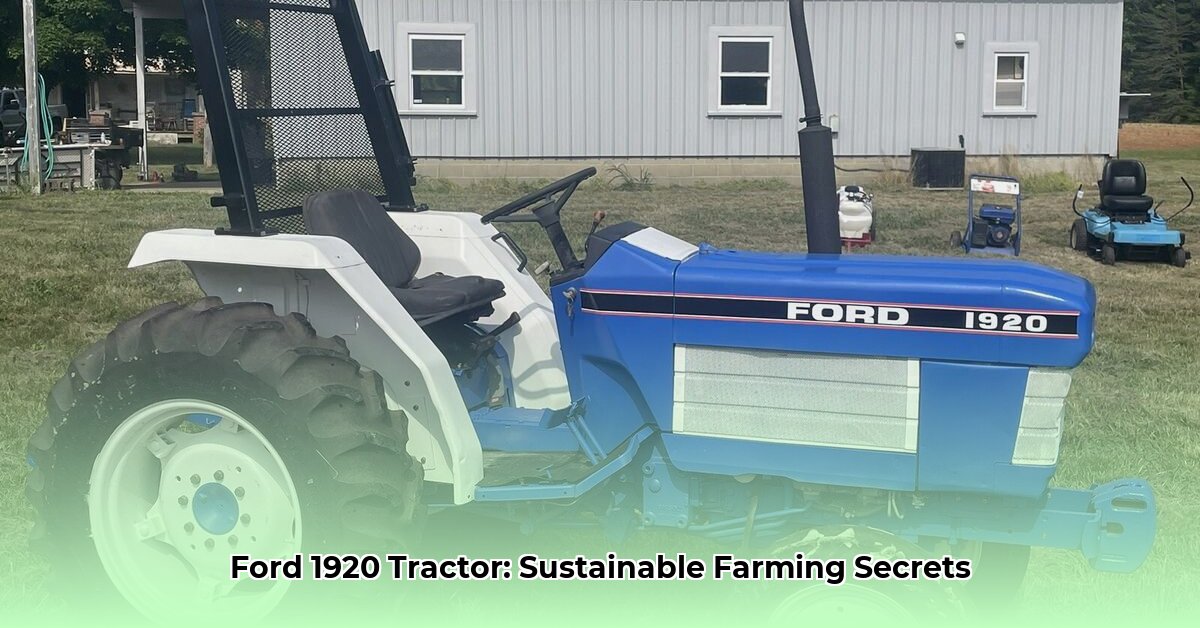
The Ford 1920 tractor, manufactured by Shibaura for Ford from 1987 to 2000, presents a unique case study in sustainable agriculture. Its vintage status prompts a critical analysis of its viability in modern farming, weighing its historical significance against its environmental impact and operational costs. For detailed specifications, see the Ford 1920 specs. This guide explores the complexities of integrating a Ford 1920 into a sustainable farming operation.
The Ford 1920: A Historical Perspective
The Ford 1920, boasting a compact design and a 33.3 horsepower engine 1, was initially prized for its maneuverability and adaptability to smaller farms. Its versatility, achieved through various attachable implements, potentially reduced the need for multiple machines, minimizing manufacturing, transport, and waste. However, its sustainability merits require closer scrutiny.
Sustainability Considerations: A Complex Equation
While the tractor's relatively small engine might have offered fuel savings compared to larger contemporary tractors, quantifiable data on its fuel efficiency and overall environmental impact is limited. Its pre-modern emissions standards compliance status emphasizes that a simple assumption of sustainability is insufficient.
Yet, the Ford 1920’s enduring legacy speaks to its durable construction. The longevity of these tractors reduces the need for frequent replacements, thereby decreasing overall waste. However, maintaining a vintage tractor presents challenges. Part scarcity can drive up repair costs, and its open-center hydraulic system might be less energy-efficient than modern designs. The question of its sustainability thus remains nuanced and context-dependent.
Assessing Viability Across Stakeholders
The suitability of a Ford 1920 is highly subjective, varying significantly among different stakeholders.
| Stakeholder | Short-Term Considerations | Long-Term Considerations |
|---|---|---|
| Small-Scale Farmers | Compare restoration costs against purchasing a newer, more fuel-efficient tractor; assess parts availability. | Evaluate government incentives for fuel-efficient equipment; explore the feasibility and cost-effectiveness of alternative fuels (e.g., biodiesel). |
| Collectors | Prioritize restoration, preservation, and historical documentation; estimate restoration costs. | Build a network with other collectors to source parts; consider alternative part creation methods (3D printing). |
| Agricultural Historians | Analyze the Ford 1920's impact on small-scale farming practices and its technological evolution. | Preserve operational manuals, photographs, and user accounts; conduct oral history interviews. |
Risk Assessment Matrix: Ford 1920 Ownership
Operating a Ford 1920 involves inherent risks requiring careful consideration and mitigation.
| Factor | Risk Level (Low, Medium, High) | Mitigation Strategies |
|---|---|---|
| Fuel Efficiency | High | Investigate and evaluate alternative fuels (biodiesel, etc.) if compatibility is confirmed. |
| Parts Availability | Medium | Network with other owners; explore 3D printing or custom part fabrication where feasible. |
| Maintenance Costs | Medium | Implement preventative maintenance; establish a relationship with a mechanic specializing in older tractors. |
| Emission Compliance | High | Comply with all local environmental regulations which may significantly restrict usage. |
| Safety | Medium | Regular safety inspections; implement available safety upgrades where feasible and appropriate. |
Legal Considerations: Emission and Noise Regulations
Compliance with current emission and noise regulations is crucial. Given its age, the Ford 1920 is unlikely to meet modern standards, potentially impacting its operational legality in certain areas. Always verify local environmental regulations before use.
How to Evaluate the Long-Term Cost-Effectiveness for Sustainable Farming
A comprehensive analysis is needed to assess a Ford 1920’s long-term viability for sustainable farming. This includes:
1. Operational Efficiency: While engine power specs are available, fuel efficiency data is scarce, hindering direct comparisons to modern machinery. Detailed records of fuel consumption over time would improve cost analysis.
2. Repair and Maintenance: The simplicity of the Ford 1920’s design could lower repair costs, but access to parts is a major variable. A detailed budget incorporating potential part acquisition, repair labor, and potential downtime should be created.
3. Environmental Impact: A complete life cycle assessment (LCA) is vital, accounting for manufacturing, operation, and end-of-life disposal environmental costs. This is a major hurdle due to data scarcity.
4. Lifecycle Cost Analysis (LCCA): A robust LCCA, encompassing initial costs (adjusted for inflation), operational expenses, repairs, and disposal costs, is needed to compare the Ford 1920's economic viability against modern tractors.
Key Practical Steps:
- Thorough Research: Gather detailed information on parts availability, repair costs, and potential fuel consumption rates.
- Budgeting: Develop a realistic budget encompassing all aspects of ownership, from initial restoration to eventual disposal.
- Risk Mitigation: Implement preventative maintenance, establish a network for parts sourcing, and ensure compliance with all environmental laws.
- Cost Comparison: Utilize LCCA to perform a comparative analysis against modern, more energy-efficient tractors.
The Ford 1920 presents both opportunities and challenges within the context of sustainable agriculture. A holistic approach, accounting for its historical context, operational costs, and environmental implications, is paramount for informed decision-making.